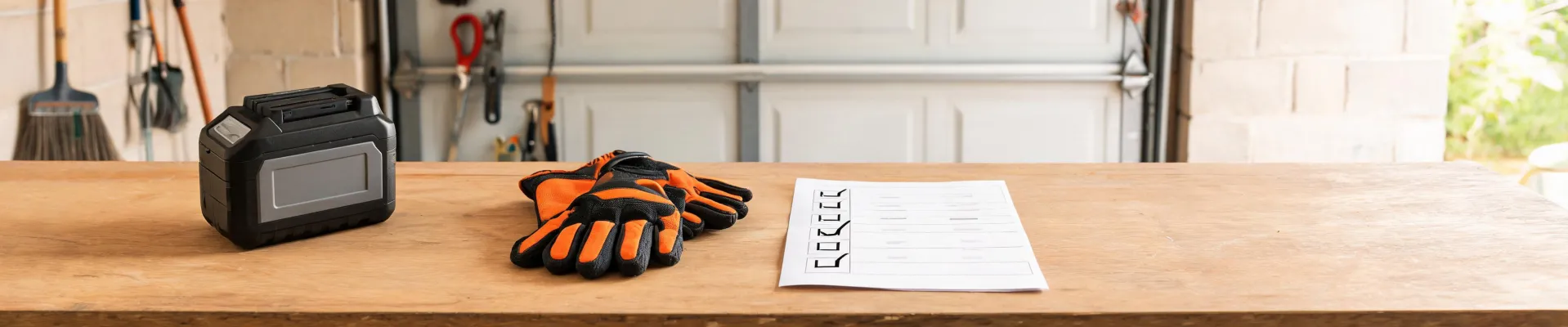
I've been handling power equipment and tool supply orders for nine years. In that time, I've personally made 13 significant mistakes, totaling roughly $9,800 in wasted budget. Now I keep the checklist for our team. I also get the strange search queries. People type 'ego earth auger tool only,' then 'ego lifting meaning,' then 'gold 6.75 lawn mower,' then 'bicycle set 3 screwdriver tool set,' and then 'what can i use instead of air tool oil.' They expect one answer. Here's the thing: there isn't one.
The old line was gas for augers, corded for mowers, air for everything else. That has changed. Cordless platforms like the EGO 56V line now handle most outdoor work without a gas can. But the fundamentals haven't changed: match the tool to the actual job, keep moving parts lubricated, and check the order before you hit send. That last one is where most of my mistakes happened.
Scenario 1: The EGO earth auger tool only decision
In my first year, I made the classic specification error. I assumed 'tool only' meant the same thing to every vendor. It doesn't. With EGO, the earth auger tool only is the auger and nothing else. No battery. No charger. If you already own EGO 56V batteries, that's fine. If not, you're adding the cost of a battery and charger to your total. I don't remember the exact price because it changes, but the surprise is what stuck with me.
Here's how I think about it now:
- Already own one or two EGO 56V batteries? Buy the tool only. A 2.5 Ah battery is light enough for fence post holes, but a 5.0 Ah or 6.0 Ah pack handles harder soil better. At least, that's been my experience with clay soil.
- Starting from zero? Buy the kit. The included battery and charger are the foundation of the EGO system. I went back and forth between the tool only and the kit for two weeks. The tool only saved money. The kit gave me the battery I needed to actually run the thing. I bought the kit.
- Need only a weekend's worth of holes? Renting a one-person gas auger or borrowing a manual post hole digger makes more sense than buying a battery auger for eight holes. I know that sounds obvious, but the biggest 'ego' mistake in this category is buying a tool for a job that doesn't exist.
Counterintuitive advice: don't automatically choose the biggest auger bit. An 8-inch bit in rocky soil can bind and kick. A 6-inch bit is easier to control. You can widen a hole later. That's a lesson from a $600 redo (this was back in 2022).
Scenario 2: If you searched 'ego lifting meaning'
If this article showed up for 'ego lifting meaning,' you might not be looking for EGO tools. Let's answer it anyway. Ego lifting is a gym term. It means loading the bar with more weight than you can control so you can say you lifted it. It doesn't build strength. It builds stories and sometimes injuries.
I used to do this. In 2019, I deadlifted 245 pounds with a rounded back. It looked fine from the outside. My back locked up for two days, and I missed a week of training. That cost me more than any tool return.
The same pattern happens with equipment. People buy the biggest, most powerful setup because it looks impressive, not because the job demands it. A 56V chainsaw is great. Is it the right tool for trimming one branch every two months? Maybe not.
So if you came here for the lifting meaning, take the lesson: choose the tool for the job, not the ego. If you actually came for EGO tools, that lesson still applies.
Scenario 3: The 'gold 6.75 lawn mower' search
Every month someone types 'gold 6.75 lawn mower.' They almost always mean an EGO mower with the 6.75 Ah battery. There is no gold model. The 6.75 is the battery capacity. And battery capacity is not the most important spec.
Here's the branch:
- Small flat lawn under 5,000 square feet: a 4.0 Ah battery is enough. The 6.75 Ah pack is heavier. Weight matters more than runtime once you're past a certain point.
- Large or sloped lawn: the 6.75 Ah battery makes sense. Extra runtime is worth the extra weight.
- Commercial or heavy seasonal use: get the 6.75 Ah—or better, get two batteries. A lunchtime charge won't keep up forever.
Counterintuitive option: if the mower's self-propelled drive is weak, a bigger battery won't fix it. Check the deck width and drive system first. I want to say the current 21-inch EGO with 6.75 Ah has been a strong seller for us, but don't quote me on exact model numbers—they change every year.
One more note. If a seller says the mower is 'zero emissions' or 'the green choice,' that is a marketing claim.
Per the FTC, advertising claims have to be true, not misleading, and backed by evidence. Source: ftc.gov.
Read the fine print, ask about the warranty, and ignore the adjectives.
Scenario 4: The 'bicycle set 3 screwdriver tool set' order
This one is a real story. A customer asked for a 'bicycle set 3 screwdriver tool set.' I pictured one set containing three screwdrivers—the kind a cyclist keeps in a saddlebag. He meant three complete screwdriver sets. One for each of his three bikes. I almost shipped the wrong thing. That was a $150 mistake waiting to happen.
So first, clarify when 'set' and '3' appear in the same sentence. Is it 'a set of 3 pieces' or '3 sets'? For a dealer, put that on the pre-ship checklist. For a rider, here's the simpler version:
For roadside repair, a 3-piece screwdriver set with a #2 Phillips, a #1 Phillips, and a flathead is usually enough. Pair it with a tire lever and a mini pump. For home work, a multi-bit screwdriver or a small ratchet set is more useful than a heavy 31-piece bike-specific kit. For a shop with multiple bikes, buy three full sets and label them. Otherwise, the customer is waiting while you hunt for a screwdriver.
The right tool matters, and so does the number of sets. I had to learn that twice before it stuck.
Scenario 5: What can I use instead of air tool oil?
This question has nothing to do with EGO, but it shows up in the same search session. Someone gets a pneumatic nailer or impact wrench, opens the manual, sees 'lubricate with air tool oil,' and doesn't have any. Then they type 'what can i use instead of air tool oil.'
Real talk: use actual pneumatic tool oil. It's cheap, designed for the job, and one bottle lasts a long time. In a pinch, I've used a few drops of 3-in-1 oil. It worked. I've also used a light hydraulic oil (ISO 32) on a jobsite when no other option existed. Running dry is worse than using a temporary substitute.
But know the boundaries:
- Don't use the classic WD-40 can as a lubricant. It is a solvent and water-displacer, not an oil. It can make a dry tool sound better for half an hour, and then the valve sticks again.
- Don't use engine oil with detergents. Detergent additives leave residue and can gum up an air motor.
- If you use the tool every day, buy the right oil. A $6 bottle is cheaper than replacing a nail gun.
Will a substitute ruin your tool? Not always. That's what makes it tempting. It might run fine for years, or it might fail on the day you need it. I prefer the $6 bottle.
How to tell which scenario you're in
Before you buy anything, ask three questions:
- Do I already have the supporting parts? For EGO, that means the 56V battery and charger. For air tools, that means oil.
- How many times will I actually use this in a year?
- Am I buying this because it solves a problem, or because it looks like something I should own?
If you already have EGO batteries, the earth auger tool only is a good route. If you don't, budget for the battery and charger. If your lawn is small, skip the 6.75 Ah pack. If you want to lift heavy without injury, leave the ego out of it. And if you're still unsure, call a dealer and explain what you're planning to do before you place the order. That's the checklist I use. It has caught 47 potential errors in the past 18 months. It sure beats the $9,800 I spent learning the hard way.

Maren Jorgensen
Maren Jorgensen is an independent hand tool and torque applications analyst covering wrenches, pliers, screwdrivers, hammers, sockets, ratchets, hex keys, and tool sets. She applies ISO 6789-1 torque-tool conformance principles while examining jaw capacity, leverage, fastener engagement, torque range, accuracy, handle geometry, and material hardness. Her practical guides help tradespeople and procurement teams select suitable tools, plan controlled tightening, and compare durability without relying on brand reputation alone.