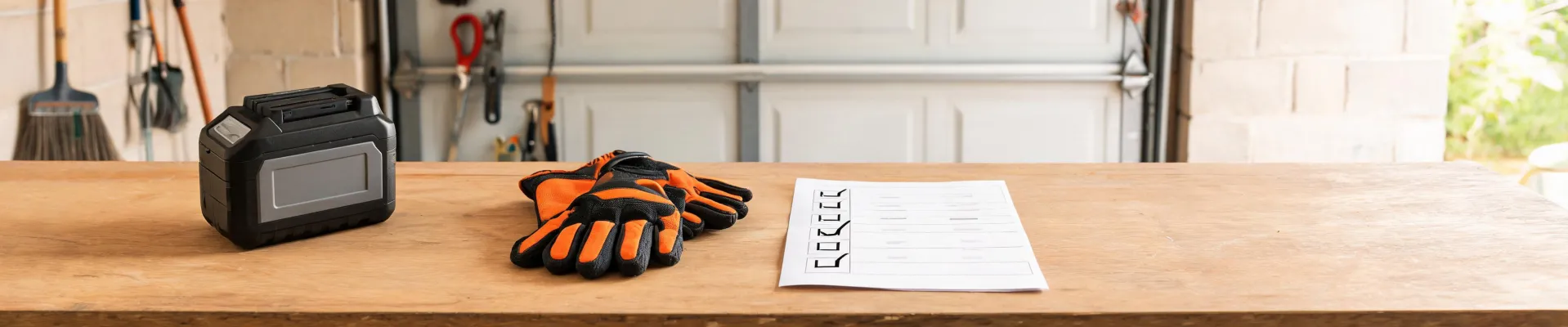
I'm a procurement coordinator at a contractor supply outfit in the Midwest. Over six years I've processed 400+ rush orders, including same-day calls from landscape crews, machine shops, and industrial maintenance teams who need a tool on-site before a shift starts. In March 2024, a commercial landscaping client called about 40 hours before a municipal contract kickoff because their gas chainsaw had seized. Standard lead time on the cordless replacement was 4-6 days. We got it done in 28 hours, but the route we took wasn't the obvious one.
Here's my honest answer to "what should I rush-order": there's no single right answer. What you should do depends on which of four scenarios you're actually in. Most people who get this wrong aren't choosing the wrong vendor — they're misidentifying their own situation.
The four scenarios
Before the specifics, here's the dividing line I use:
- Scenario 1: Cordless outdoor power equipment (chainsaws, mowers, blowers) against a hard deadline
- Scenario 2: Small hand tools (pliers, drivers, wrenches)
- Scenario 3: Lifting and rigging gear (chain hoists, slings)
- Scenario 4: Pneumatic setups (impact wrenches, air hoses)
Each one has a different risk profile, and each one justifies a different amount of rush spend. Some justify none.
Scenario 1: Cordless OPE on a hard deadline
This is the scenario where rushing pays off most reliably. Landscape and municipal crews often don't have a plan B that runs on two-cycle fuel anymore — a lot of contracts now specify electric for noise and emissions reasons, so the replacement has to be cordless.
From the outside, picking a replacement looks like a battery-size comparison. The reality is you're buying into a platform you'll be locked into for at least three to five years. If your crew already runs one brand's batteries, replacing the tool alone is a two-day problem. If you're switching platforms mid-season, you're buying batteries, chargers, and often a case at the same time — that's a five-day problem minimum, and no freight option fixes it.
Take something like the EGO battery powered chainsaw. It runs on the 56V ARC Lithium platform, and that detail matters for a specific reason: if your crews already run mowers or trimmers on that system, the chainsaw is a same-battery add. If they don't, the total cost of ownership math changes, and rush-shipping a saw without matching batteries is a mistake I've watched people make twice.
The EGO chainsaw case question comes up on almost every call, and it's worth a minute. The case isn't cosmetic — it's the thing that keeps a ~$200-450 tool from getting crushed in a truck bed or dropped off a trailer. I've seen crews skip the case to save $40 on a rush order, then lose the bar and chain to impact damage inside two months. If you're already paying for expedited shipping, put the case on the same ticket. One box is almost always cheaper than shipping a saw this week and a case next week.
Where rush spend is justified here: hard deadline, no working fuel alternative, and the battery platform is already in place. Premium I've seen run 15-30% over standard shipping. Worth it every time I've watched it play out.
Scenario 2: Small hand tools (pliers, drivers, etc.)
This is where almost everyone overpays. A 4-inch pliers — the kind used for precision electrical work, hook removal, or tight-space gripping — is stocked at every industrial supply house within about a 60-mile radius of any decent-sized city. There is very little reason to rush-ship one.
I still kick myself for a same-day order in 2023: a client needed a specific 4-inch needle-nose set for a Friday deadline. We overnighted it for around $58 in shipping on a $22 tool. The customer could have driven 40 minutes to a distributor and been back by lunch. What he actually needed was installation time, and he had that. I didn't ask the right question before I clicked "ship."
Rule of thumb: if the tool is under $50 and it's a standard catalog item, call the closest distributor before you place an online rush order. The cheap tool that arrives in 36 hours is often more expensive than the one you pick up today.
Scenario 3: Lifting equipment (chain hoists)
Here's the counterintuitive one. Chain hoists are the category where rushing is most likely to bite you — but not for the reason people expect.
The surprise isn't shipping time. It's that chain hoists in most commercial settings need a load test and inspection before they can legally be used on a jobsite. A 1-ton manual chain hoist can ship in 24 hours, but the inspection process still adds 2-5 days on the back end no matter how fast the freight moves. Overhead hoist inspection and load-test requirements are covered in the U.S. by ASME B30.16, and the requirement that it be done per serial unit is often what adds the delay. I've had three clients learn this the hard way — they paid for overnight freight and then sat on the tool for a week waiting on paperwork.
If you're in this scenario, the useful question isn't "who ships fastest." It's "who ships fastest and can supply the inspection documentation for this specific serial unit." Most distributors can't. The ones who can usually charge a documentation fee, not a freight fee. Pay it. The freight premium is a rounding error compared to a jobsite shutdown.
Note: load test and inspection requirements vary by jurisdiction and application. Verify with the applicable authority before assuming — I'm describing what I've seen, not a universal rule.
Scenario 4: Pneumatic setups
Pneumatic work is where sizing mistakes cost the most, and where the rush decision is almost never about the tool — it's about the hose.
For a 1/2-inch drive impact wrench, the industry rule of thumb is a 3/8-inch inside-diameter (ID) air hose for runs up to roughly 25 feet, and 1/2-inch ID beyond that. A common mistake: buying a cheap 1/4-inch ID hose because it's rated for the same working pressure (usually 300 PSI). The pressure rating is fine. The flow isn't. A 1/4-inch hose starves a 1/2-inch impact at the fitting, and you get noticeably less than rated torque with no obvious symptom other than the tool feeling weak.
If you're rushing an order in this category, put the hose on the same ticket as the tool. I've seen four separate jobsite issues in the last two years where the tool was fine and the hose was the bottleneck, and every one could have been caught by reading the ID spec on the box.
For a 1-inch drive impact, expect 1/2-inch ID minimum, often 3/4-inch. If you're not sure, buy one size up. The price difference is $8-15, and undersizing is the single most common reason people think a new impact wrench is defective. (It usually isn't.)
How to tell which scenario you're in
Three questions, in order:
- Is your deadline actually hard? If a late delivery costs you a contract, a client, or a crew's payroll for a full day, you're in the pay-for-certainty frame. If it costs you an inconvenience, you're not.
- Is the tool the real bottleneck, or is it certification, inspection, or installation? If the bottleneck is downstream of delivery, expediting the tool is theater. You're solving the wrong problem, and paying for it.
- Can you get it locally today? For standard catalog items under $50, this is almost always the answer, even at a small markup.
The trap I see most often isn't bad judgment about vendors. It's people who default to "rush everything" and then wonder why their expedite spend isn't moving their on-time rate. In my experience, the jobs that actually need a certainty premium are the ones where the deadline is hard and the tool is on the critical path. For everything else, the boring option — local pickup, standard shipping, or a scheduled order with buffer — wins.
Prices and specifications referenced are current as of early 2025; verify current rates and standards before ordering. Regulatory requirements for lifting equipment vary by jurisdiction and application.

Helena Duarte
Helena Duarte is an independent pipe, valve, and pump applications analyst covering fittings, ball valves, gate valves, check valves, butterfly valves, flanges, hose clamps, centrifugal pumps, sump pumps, and submersible pumps. She uses ISO 5208 pressure-testing concepts and ISO 9906 pump acceptance methods while comparing pressure class, seat leakage, Cv, head, flow, efficiency, solids passage, seal materials, and installation orientation. Her guides help specifiers and maintenance teams match fluid-handling components to service conditions and acceptance criteria.