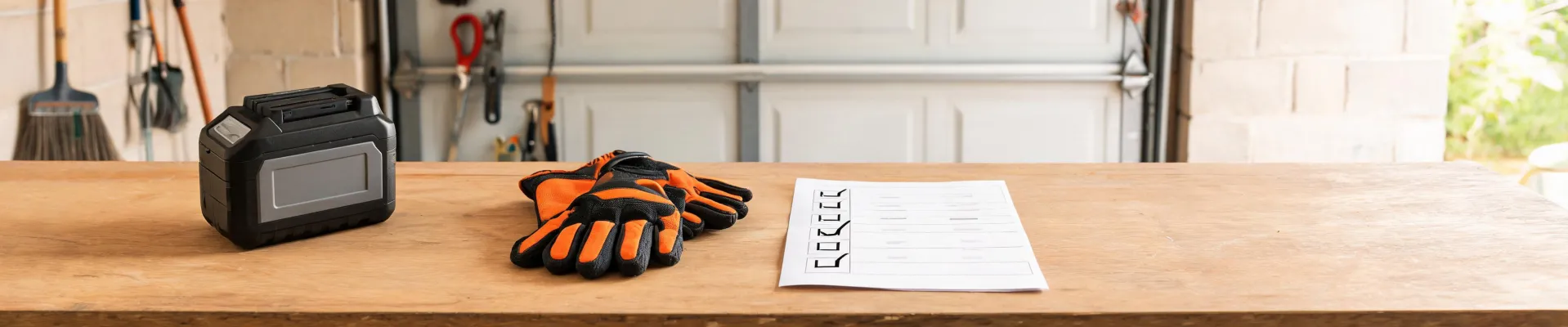
It was late October 2025, and the first snow shovel order of the season showed up on a Tuesday morning. Twelve boxes of the EGO snow shovel tool only (no battery) version, all identical, all clean. I remember thinking this was going to be the easiest inspection of the year.
I'm the quality/compliance manager at a power equipment dealer. I review every unit before it reaches customers—roughly 400 items a year. In 2024, I rejected about 7% of first deliveries because the spec on the order didn't match the spec in the box. I don't enjoy sending things back. But I do enjoy catching a problem before the customer does.
The Order That Looked Easy
The contractor who placed the order was a landscaping outfit. In spring, they'd bought EGO lawn mowers from us, so they already owned a set of EGO 56V batteries. Their winter plan was simple: order the EGO snow shovel tool only (no battery) and use the mower batteries. That's exactly how EGO's 56V ARC platform is supposed to work—one battery, many tools.
But the same purchase order had a line item that made me pause: 'battery for a riding lawn mower.' It was a cheap universal replacement from a marketplace site, not an EGO battery. I called the owner before the order moved to picking.
He told me, 'The dealer wants too much for the EGO one. This said it fits riding mowers.' I get why that sounds tempting. But a generic battery for a riding lawn mower is not automatically compatible with EGO equipment. EGO's 56V batteries have a specific connector and battery management system. According to EGO's product pages (egopowerplus.com) as of October 2025, the 56V ARC battery is the shared power source across EGO lawn mowers, blowers, chainsaws, snow shovels, and the ride-on mower. That's why tool only works for someone already in the ecosystem. But 'fits riding mowers' on a product listing doesn't tell you whether it fits the mower's battery platform. Verify current compatibility on EGO's site when you order.
He updated the line item and thanked me. I figured that was the end of the drama. Then one of the twelve snow shovels wouldn't start.
The One That Wouldn't Start
I plugged a test battery into the unit. Nothing. No lights, no motor. My first thought was that the snow shovel was dead on arrival. I set it aside, tried another battery, and it ran fine. The tool was okay. The first battery was the problem—a tired 2.5Ah unit from their mower fleet that had tripped its low voltage protection.
I had just spent the morning thinking about battery compatibility, and then I missed the simplest version of it. (It cost me half my lunch break and some reputation with the warehouse guy, but at least I caught it before shipping.) Now we have a protocol: if a cordless tool won't run, test the tool with a known-good battery first. I should have written that rule after the first time. Not the third.
The Side Project That Made Sense of It
While I waited for the battery to charge, my assistant called me over to the workbench. We were building a small rack to hold EGO battery chargers in the shop. He was holding a drill and a hole saw. 'Can I use a bi-metal hole saw on wood?' he asked.
The short answer is yes. A bi-metal hole saw is a solid default for a shop that switches materials often. Run it at a slower speed than a wood-specific bit, let the teeth do the cutting, and clear the sawdust every few seconds. We cut two 1-1/4 inch holes through the plywood backing in under a minute.
Then I needed to attach the charger brackets to the board. The package on the bench read 'wood insert nut 8 x 32 brass (2 pack).' I'd ordered it the day before. For something that small, thread size matters: 8-32 means a #8 screw with 32 threads per inch, and it's not the same as 10-24 or a metric thread. I checked the package before drilling the pilot hole, just like I check battery part numbers before recommending a replacement. It's the same habit, just a smaller spec.
What I Took Out of It
All twelve snow shovels left the dock on schedule. The generic riding mower battery line was replaced with the correct EGO battery. The charger rack is solid. My assistant learned that a bi-metal hole saw works on wood if you slow down a little.
I used to define quality by visible issues—dents, scratches, cracked handles. But that day, a dead battery and a brass insert nut taught me something else. Quality is also about systems and specs. 'Tool only' only makes sense if the customer already owns the right battery. A bi-metal hole saw only works if it's used at the right speed. An 8-32 brass insert only works if the pilot hole is sized for it. Every one of those is a spec, and every spec is a chance to get something wrong.
That's why I don't mind spending ten minutes explaining a battery platform before a sale. I'd rather do that than send a customer photo of a return label. An informed customer asks better questions and makes faster decisions.
An informed customer asks better questions and makes faster decisions.
I don't expect every buyer to know the difference between an EGO 56V ARC battery and a generic battery for a riding lawn mower. That's my job. But when they leave with the right part and a clear reason why, the next order usually comes with fewer surprises. That's about as close to a happy ending as I get in quality control.

Maren Jorgensen
Maren Jorgensen is an independent hand tool and torque applications analyst covering wrenches, pliers, screwdrivers, hammers, sockets, ratchets, hex keys, and tool sets. She applies ISO 6789-1 torque-tool conformance principles while examining jaw capacity, leverage, fastener engagement, torque range, accuracy, handle geometry, and material hardness. Her practical guides help tradespeople and procurement teams select suitable tools, plan controlled tightening, and compare durability without relying on brand reputation alone.