I'm a quality/compliance manager at EGO. Before a mower, chainsaw, trimmer, blower, snow blower, or pressure washer ships to a distributor, I'm the person who signs off on the batch. I've reviewed roughly 200 product variants a year for the past four years, and I have a strong opinion: prevention beats replacement, every single time.
That sounds like a slogan. I mean it as a process. In Q1 2024, I rejected roughly one in ten first-round submissions because of spec mismatches—not because the tools didn't run, but because the details didn't line up. I've also stood in front of a pallet of 8,000 units and thought, 'If we'd spent 15 more minutes in the design review, that defect would've been caught.' So when a professional buyer asks me what to check before buying EGO tools, I don't start with features. I start with checks.
5 minutes of verification beats 5 days of correction.
A Complete Specification Is a Promise
Here's an example from outside the battery world. I once audited a 320-piece mechanic's tool set for a promotion. The packing slip said 320. The physical count said 319. The missing piece was a 10 mm socket—the one you'll need first. The vendor said 'within delivery tolerance.' It wasn't. We sent it back, and the promotion shipped late. The lesson: if you don't count the small items, the customer counts them for you.
Same principle in outdoor power equipment. A 56V battery platform is only useful if every pack on the shelf meets its runtime spec. The label is not the spec. The specification is what the tool does under a load, at a discharge rate, in conditions you'll actually see. I've rejected batteries that looked fine on a multimeter but failed a 5-minute load test.
The Screwdriver Battery Is a Warning Sign
Small parts have a way of becoming big problems. Take the screwdriver battery. It's the smallest power source in a shop, and the easiest one to neglect. It gets left on a cold truck, plugged into the wrong charger, or swapped between tools that don't share the same voltage. Last quarter, a service ticket came back labeled 'battery won't charge.' The battery was fine. The charger wasn't compatible. A 30-second model-number check would have prevented the whole return.
Here's something vendors won't tell you: a battery's rated capacity is a lab number, not a field number. The numbers said our new pack was within spec. My gut said the discharge curve was too optimistic. We ran a cold-soak test and found the runtime dropped by a third at 0°F. We sent it back to the lab. The data was about the lab, not the field.
Which Way Does Angle Grinder Blade Go? The Check Is Cheap
One of the most common support questions I see is 'which way does angle grinder blade go?' It's not a joke. It's a safety check. The answer: align the arrow on the blade with the arrow on the guard. If the arrows don't line up, stop.
A backward blade reduces cutting speed, increases heat, and creates a kickback risk. It also turns a quick cut into a five-minute rework. I've opened 'defective' angle grinders that were completely fine—the blade was just mounted upside down. That's not a quality issue. That's a skipped check.
The Receiving Checklist I'd Put On Every Order
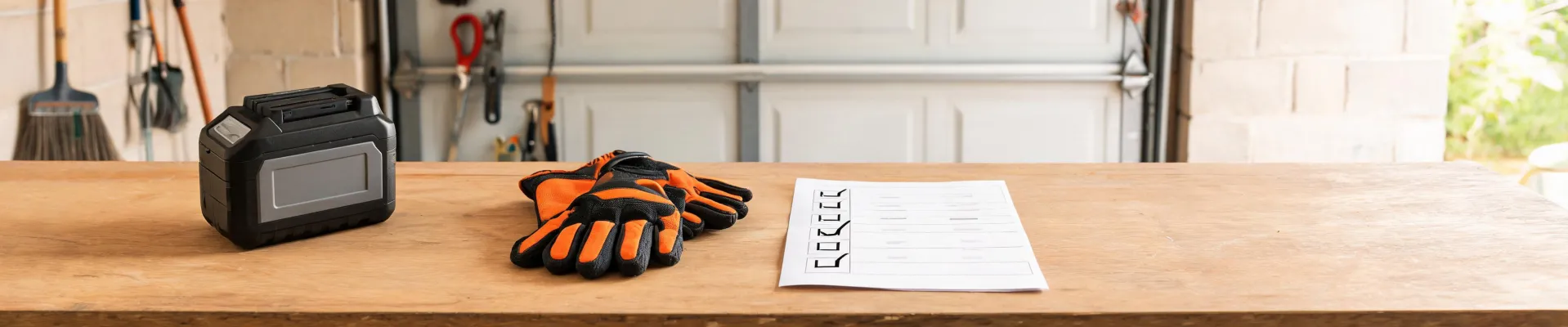
Here's the list I would put on your receiving table, whether the box contains a 56V mower or a simple screwdriver battery:
- Verify the model number against the packing list. If the box says one thing and the label says another, hold the shipment.
- Count the included pieces. The 320-piece mechanic's tool set taught me that 'complete' is a spec, not a marketing word.
- Check rotation arrows and guards. With angle grinders, answer the 'which way does angle grinder blade go' question before you power up, not after.
- Run a load test on every battery. A charged voltage reading is not a battery test.
What About the Warranty Argument?
To be fair, warranties matter. EGO has a warranty and support network that professionals rely on, and I don't want to sound like I'm against returns. A return is the right outcome when a product genuinely fails. But a warranty replaces the part; it doesn't replace your schedule. The contractor who loses a morning because a trimmer won't run doesn't care about the warranty claim as much as the missed job.
Granted, some failures are unavoidable. Batteries age. Blades wear. Motors burn out if abused. I'm not promising otherwise. But the failures you can predict are the ones I care about most.
What I Actually Read in EGO Lawn Mower Reviews
I read EGO lawn mower reviews the same way I read test reports: for clues. A review that says 'on a third of an acre with damp grass, the 56V battery went from full to 40% in 25 minutes' is useful. It tells me something about load and runtime. A review that says 'the mower stopped after two months' and never mentions the safety bail, the blade, or the battery? That's a symptom, not a diagnosis.
In my experience, the best review comments are the ones that describe conditions. The same is true for every EGO tool. Mowers, chainsaws, trimmers, blowers, snow blowers, pressure washers—they all work as a system when the batteries are healthy, the guards are in place, and the operator knows the checklist. That's why prevention is not the boring part of quality. It's the entire point.
Here's my bottom line. I've reviewed thousands of tools, and the painful problems are rarely the dramatic engineering failures. They're the small checks that got skipped. Check the blade arrow. Load-test the screwdriver battery. Count the pieces in the set. Read the manual once. It's not glamorous, but 5 minutes of verification beats 5 days of correction. That's the opinion I'll never change.

Maren Jorgensen
Maren Jorgensen is an independent hand tool and torque applications analyst covering wrenches, pliers, screwdrivers, hammers, sockets, ratchets, hex keys, and tool sets. She applies ISO 6789-1 torque-tool conformance principles while examining jaw capacity, leverage, fastener engagement, torque range, accuracy, handle geometry, and material hardness. Her practical guides help tradespeople and procurement teams select suitable tools, plan controlled tightening, and compare durability without relying on brand reputation alone.