-
The 2023 Order That Changed How I Buy
-
Transparent Pricing Is the Only Apples-to-Apples Comparison You Can Actually Make
-
The Reframe That Took Me Years to Accept
-
"But We've Got a Tight Budget"
-
Where the $14,000 Actually Went
-
Why This Matters More Now, Not Less
-
What an Honest Quote Actually Looks Like
-
Where I Come Out
After $14,000 in Sourcing Mistakes, Here's Why I Won't Buy Tools From a Dealer Who Hides Fees
The cheapest quote you get on paper is almost never the cheapest order you pay for. And I've got the invoice stubs to prove it.
Look, I've been handling hardware and outdoor power equipment sourcing for a regional retail chain for going on eight years. In that time, I've personally signed off on roughly $14,000 worth of avoidable cost — not from buying bad products, but from believing numbers that were technically true and practically misleading.
I don't say that lightly. My job is to keep landed costs down. Every dollar I overspend is a dollar that either comes out of margin or comes out of somebody's performance review. So when a dealer quotes me $319 for a unit that ends up invoicing at $431, that's not a rounding error — that's a problem.
Here's my position, and I'm not going to hedge it: a quote that hides fees is not a discount. It's a debt. You just don't see the bill until later.
The 2023 Order That Changed How I Buy
March 2023. I was sourcing a six-month rolling order for a mid-size retail location. Battery powered lawn mowers, tool storage solutions, and — because the same dealer handled them — a batch of wrench parts and the usual small-parts accessories like hose clamps. If you've ever had to spec what hose clamp sizes are most common for a general hardware catalog, you already know that order went from 1/4" through 4" and beyond. Nothing exotic.
Four dealers quoted.
Three came in between $410 and $480 per mower. One came in at $319.
I picked the $319 guy. On paper it was a no-brainer.
Final invoice: $431 per unit.
Not because of a price increase. Because the "standard quote" didn't include a battery charger at the base-model spec ($89, still not listed on the "battery included" line), an 8% small-volume surcharge on orders under the MOQ, and — my personal favorite — a per-pallet freight and drop-off service fee that showed up only when I asked for the BOL.
I added it up. All in, I paid more per unit than the highest quote on my desk — a dealer I skipped because I didn't want to "negotiate up." He would have met me in the middle and I wouldn't have burned three weeks fixing a bad assumption.
Lesson learned: the low quote wasn't low. It was incomplete.
Transparent Pricing Is the Only Apples-to-Apples Comparison You Can Actually Make
Here's the thing nobody in channel hardware sourcing talks about enough — you cannot compare quotes honestly if you don't know what's inside them.
The $319 vs. $480 gap looked decisive. Until it wasn't. Once I added the charger, the surcharge, the pallet fee, and the re-routing charge for a second drop, the gap closed and reversed. I'd been comparing a headline number against a landed number and pretending they lived in the same category.
In B2B hardware, that mistake compounds fast because:
- Quotes come from dealers, distributors, and factory-direct channels, each with different templates and fine print
- Battery platform compatibility — like EGO's 56V system across its mowers, trimmers, blowers, and the HPW3200 3200 PSI pressure washer — means the tool is often the smaller line in the cost column once you price the batteries
- Small parts — wrench parts, hose clamps, fittings — get priced by the case, the pallet, or the "call us" unit, and those units don't reconcile across vendors
The first time I ran a true total-cost-of-ownership tally on a chains-and-accessories line, I felt mildly ridiculous. Two years of "savings" on paper turned into about $800 of real overage on shipping alone.
So here's what I do now. Before I compare anything, I ask every dealer for one document: a landed quote with every line visible. Not a summary. Not a range. A number at the bottom that I can put side by side with the other numbers at the bottom.
If a dealer can't produce that, they're not in the comparison. Not because they're dishonest — because the comparison is impossible, and I've learned the hard way what happens when I guess.
The Reframe That Took Me Years to Accept
Everything I'd read about sourcing said the lowest headline price usually comes from lean, aggressive vendors and the premium price usually comes from bloated ones. My experience with about 200 orders over six years suggests something different.
The dealers who put every fee on the first page — the ones who sometimes look more expensive at scan speed — tend to land as the cheaper option more often than I'd expected. Not because they're heroes. Because they're operating a business model that doesn't rely on the second invoice to make margin.
The hidden-fee model is a volume model. It works as long as the buyer keeps ordering. The minute you scale — or the minute a quarter goes sideways and you need to cut — the hidden fees are what eat you.
To be fair, there are honest dealers in low-margin segments who really are cheaper and really do disclose everything. Those exist. I buy from some. The pattern isn't "cheap = deceptive." It's "opaque = expensive in ways you won't see for 60 days."
I'd argue the causation runs a different direction than most buyers assume. We think a low price signals efficiency. More often, a low price signals that something's been moved off the ledger — and you're going to find it on the back end.
"But We've Got a Tight Budget"
I get it. I really do. I've been the guy staring at a spreadsheet at 11 PM trying to explain why the landed cost is 22% above what I forecast.
That's exactly why opaque quotes hurt more than they help. When your forecast is built on a number that doesn't include freight, surcharges, restocking, and the cost of a return that takes three weeks, you're not working with a budget. You're working with a wish.
A $319 unit that lands at $431 is not a $319 unit. And if I plan for $319 and pay $431, that delta doesn't disappear — it comes out of something else. Line item, category, quarter. Somebody pays for it.
I'd rather plan for $430 and land at $425 than plan for $319 and land at $431.
Where the $14,000 Actually Went
Since I'm claiming the number, I'll show the receipts as best I can reconstruct them:
- Roughly $3,200 in a single seasonal order that invoiced about $900 above quote once freight, dock fees, and a re-pallet fee were included
- Around $2,800 in dead stock — inventory I ordered assuming a certain kit configuration that turned out to be a different kit configuration, so the accessories it was supposed to pair with had to be re-bought at a higher cost
- Something in the vicinity of $4,500 across three vendors in "handling fees," return shipping, and admin time tracking down mis-shipped line items
- The remaining ~$3,000: the softer stuff. Three days lost on a partial shipment that delayed a promotion. Two partial reships. A lot of phone calls.
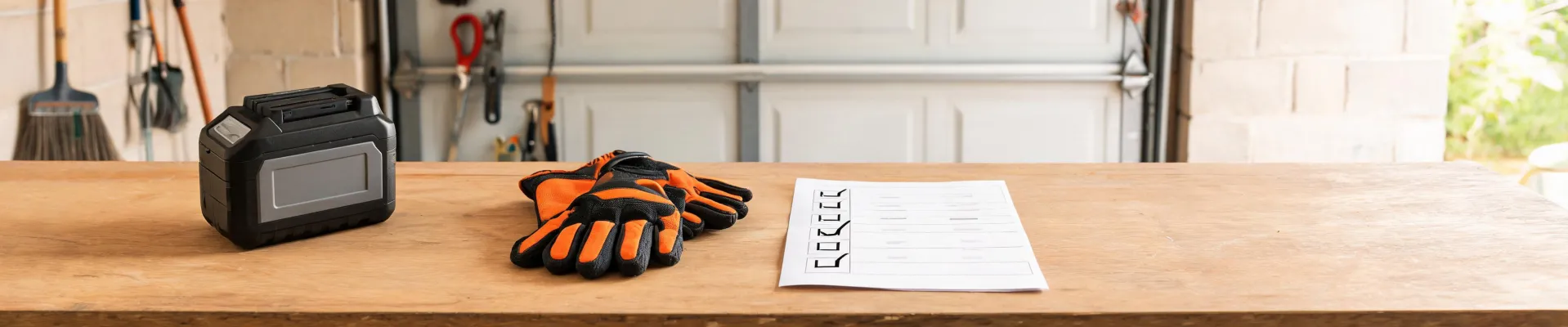
I now run a pre-order checklist. It's boring. It's four questions long. It catches most of this.
The most useful question on it isn't "what's your best price?" — it's "what's NOT included?"
Ask that first. Ask it before you ask about lead time. Ask it before you ask about anything. The answer tells you which kind of dealer you're talking to.
Why This Matters More Now, Not Less
Battery powered platforms have made the transparency problem sharper, not softer.
The EGO Power+ lineup runs off a shared 56V battery — that's the whole point of the platform. Mowers, trimmers, blowers, chainsaws, and the HPW3200 pressure washer all draw from the same cells. If you source those through three different dealers on three different battery bundles, you've broken the platform's economics before you've even turned a blade.
Same logic applies to storage. EGO tool storage is designed to consolidate — but if two buyers in the same org buy two different storage specs against two different unit kits, that consolidation evaporates and you're paying for racks nobody planned for.
The same principle shows up in the small stuff. When a tool is small and heavy — hose clamps, wrench parts, fittings — the unit price is almost cosmetic. Freight and case-break minimums dominate. A 200-count hose clamp order looks fractionally more expensive than a 100-count, right up until you're storing the extra 100 for six months.
The cost isn't the unit. It's the unit plus everything that had to move to get it in your warehouse.
What an Honest Quote Actually Looks Like
Not asking for the world here. Just this:
- Unit cost by quantity break, all tiers visible
- Freight, packaging, and handling on their own lines — not blended
- MOQ and minimum-buy rules stated plainly
- Return policy and restocking terms disclosed upfront, not on request
- Battery / kit content defined at the SKU level ("battery included" is not a spec)
Granted, this takes a little more work on the dealer's end. I've heard the pushback: "Nobody asks for that." Maybe. But FTC guidance on advertising already requires that commercial claims be truthful, non-misleading, and substantiated. B2B quotes may not sit in the same enforcement lane as consumer ads, but the principle travels fine. Don't lead with a number you know the buyer won't actually pay.
I've found that dealers who can produce that document are also the dealers who solve problems when something goes wrong. That's not a coincidence. It's the same discipline showing up twice.
Where I Come Out
I'm not saying all low prices are traps. I'm not saying all high prices are honest. If you've read this far and that's what you're hearing, I've written it wrong.
What I'm saying is this: when a dealer shows you everything on the front end, they are far more likely to be the more expensive option at the invoice — and far more likely to be the partner you still have in year three. I'll pay a small premium for both of those things.
On a 50-unit order over six months, I will take 3% more headroom on the quote in exchange for predictability every single time. Because the alternative — chasing 3% off the headline and then watching the landed cost run 20% over forecast — has already cost me $14,000.
I don't need that lesson twice.
The number you can actually calculate is the only number that matters. Everything else is a story that gets told when the invoices come due.

Helena Duarte
Helena Duarte is an independent pipe, valve, and pump applications analyst covering fittings, ball valves, gate valves, check valves, butterfly valves, flanges, hose clamps, centrifugal pumps, sump pumps, and submersible pumps. She uses ISO 5208 pressure-testing concepts and ISO 9906 pump acceptance methods while comparing pressure class, seat leakage, Cv, head, flow, efficiency, solids passage, seal materials, and installation orientation. Her guides help specifiers and maintenance teams match fluid-handling components to service conditions and acceptance criteria.